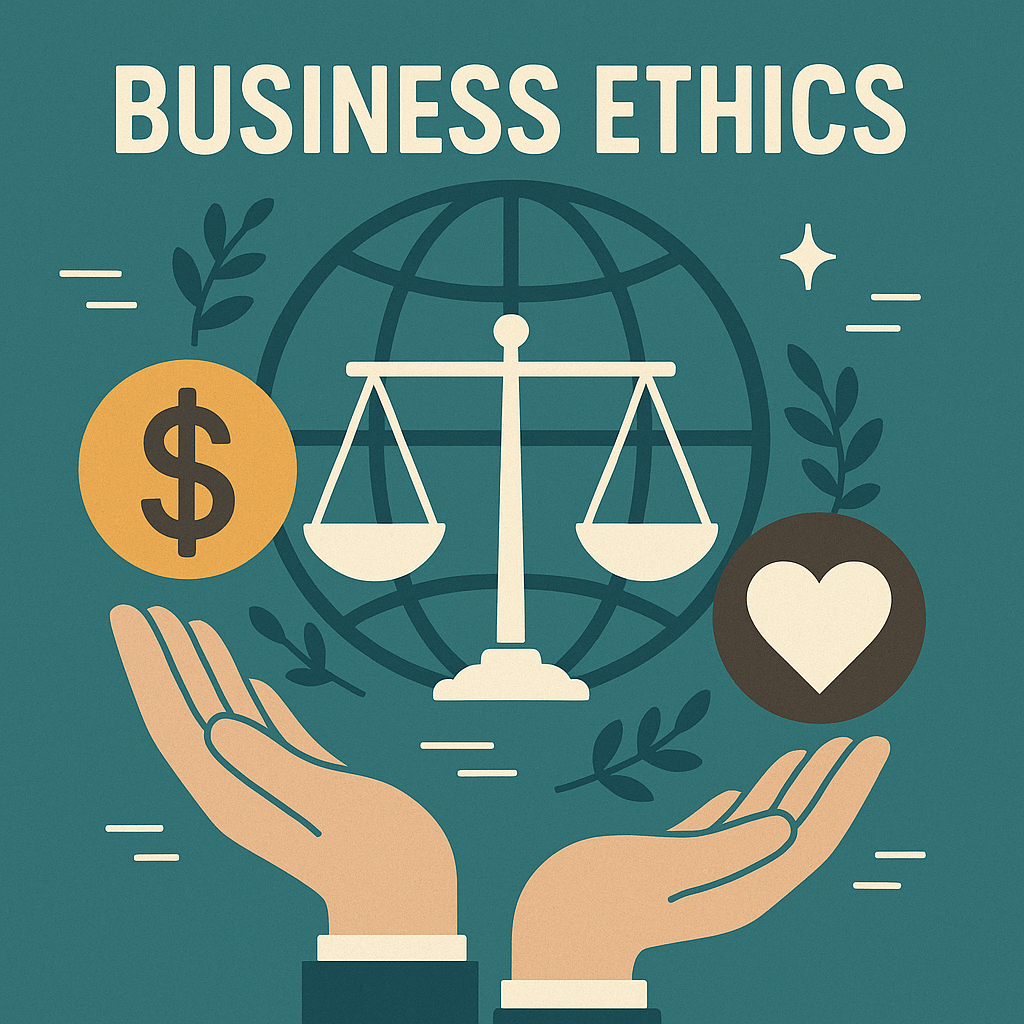
When companies face scandals – for example, about child labor in supply chains or misleading “green” advertising – we are reminded why business ethics matters. Businesses are not only about profit but also about responsibility, fairness, and trust. In this seminar, we will not simply read theories but engage in active discussions, debates, and case studies. The goal is to practice giving reasons, weighing arguments, and defending positions clearly. At the heart of ethics lie two key questions: What makes a good life? And what is justice? These questions will guide our reflections throughout the course.
(source of the picture: ChatGPT)
- Dozent/in: László Kovács

Corporate Governance is the legal and factual framework for the management and supervision of a company. Incomplete
contracts and differing interests principally provide opportunities for
stakeholders as well as motives for opportunistic behavior. In
this course we will discuss principles on corporate governance that
have the task of restricting the leeway and motivations of the actors
for opportunistic behavior through appropriate arrangements.
- Dozent/in: Stephan Zimmermann
Managing People will give students an overview about classical areas of International Human Resource Management, including some insights into behavioral psychology and general management topics like leadership and intercultural management.
This course will be held online on Wednesdays afternoon from 14:00-17:00h. Eventual Zoom data can be found in the course.
- Dozent/in: Michael Freiboth
Topics: In this class, we will look at financial economics from a microeconomic as well as a macroeconomic perspective. Furthermore, we will discuss policies related to financial economics issues. Regarding the microeconomic aspects of financial economics, we will address questions such as: What are the functions of financial systems? Which problems could arise and how can those be addressed? How do firms, institutions and regulatory agencies try to ensure that the financial system works? Why is the regulation of financial systems important? With respect to the macroeconomic aspects of financial economics, we will address questions such as: How does monetary policy work and how does monetary policy impact financial markets and the economy? What can be the causes of inflation and how can central banks address inflation? What types of exchange rate systems can a country choose and what are the consequences for monetary policy? In terms of policies related to financial markets, we will address questions such as: What are important institutions in the international financial system? Why can a financial crisis occur and what could be measures to deal with a financial crisis? Should central banks pursue green monetary policy? What are current pressing issues regarding global financial stability and by which policies can such problems be addressed?
Date: Wednesdays, 09:30 - 12:30 (room: W1.10)
Assessment and contribution to module mark: written exam
Credits: 4 SWS / 6 CPs
Lecturer: Prof. Dr. Maria Lehner
- Dozent/in: Maria Lehner